Wednesday 9th October
Observation V Experience
In this lecture we looked at Expressionism and how it evolved, how different painters achieved different feelings from their pieces, and the true meaning of expressionism. (Please excuse my lack of prose towards the end; my notes in bullet form are still easy to understand, but I ran out of steam to translate it all into flowing paragraphs...)
The artist's studio is quite a common subject for artists.
The Salon- 1854, Gustave Courbet

We can see the artist in the center, with groups of people either side of him. There is a clear divide between social classes; high society and low society. The richer folk are on the right where the lower class are on the left. Yet all seem to be brought together by a shared appreciation for the artist. There is also a nude model stood by the artist even though the painting he is working on is clearly not a nude study, but a landscape. This is a modern painting of the modern world (at the time is was created).
Red Studio- 1911, Matisse

This painting is more insular, more personal than the first. It's a very abstract representation of Matisse's workspace, and yet it is clearly an artist's studio because of the typical elements we can see around the room, such as paintings, easels and the like. The largest abstraction is the minimal palette he has used, which is essentially just red, yellow and black. There is a rather flat technique with not much attention paid to dimensional proportions. The artist himself is not present in the painting, but it is typical of his particular style; Fauvist.
Kirchner's Berlin Studio (photograph)- 1919, Robert Kirchner

Once again we can see the familiar objects of an artist's studio; a sofa, paintings, a model, and other random supplies that one would expect to find in a space where a lot of time and energy is spent. The big question is why the model is dressed and yet the artist himself is nude? The answer is not very clear, but again, as I mentioned in a previous post, we only see what the artist wants us to see. He wants us to see a devil-may-care, bohemian, eccentric artist who has chosen to be different and fun and energetic.
Robert Motherwell, photo 1962
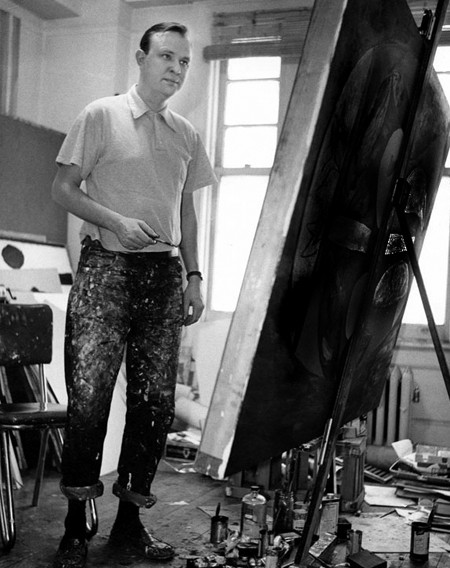
This photograph differs greatly to Kirchner's representation of a studio. The space looks much more typically 'arty' and less like a relaxed 'hangout zone'. The artist is dressed in clothes that were seen as fashionable and edgy at the time; big boots, jeans and a polo shirt. He looks typically manly and is concentrating seriously on his work as opposed to looking at the camera. Once more, though, we can clearly see standard artist supplies like paints, canvasses, easels etcetera. Another similarity to Kirchner's photograph is that they are both black and white, but this may be coincidence on Motherwell's part as to whether he chose to use black and white film or not.
These paintings show the relationship between the artist and the studio as varying over time.
Meeting- 1854, Courbet

In this painting we can see Courbet himself greeting the rich bourgeoisie gentleman who commissioned the painting. There is a clear difference in dress-- Courbet looks casual, whereas the patron looks formal and rigid-- although not in respect or social standing. Courbet and the patron would have both been greatly respected. This demonstrates relationships, attitudes and critical distance between them.
VIDEO-- An interview with Francis Bacon
In the video, Bacon said he aimed for the following in his work:
- visual shock
- spontaneity, recklessness
- no real meaning
- intuitively knowing when it was complete
UNDERSTANDING EXPRESSIONISM
Expressionism
- A distortion or emotion to exaggerative effect.
Expressionism UNLIKE CUBISM, uses intense color, exaggerative brush strokes, disjointed space.
Tolstoy says everything is art, if it evokes feelings.
The Night Cafe- 1888, Vincent Van Gogh
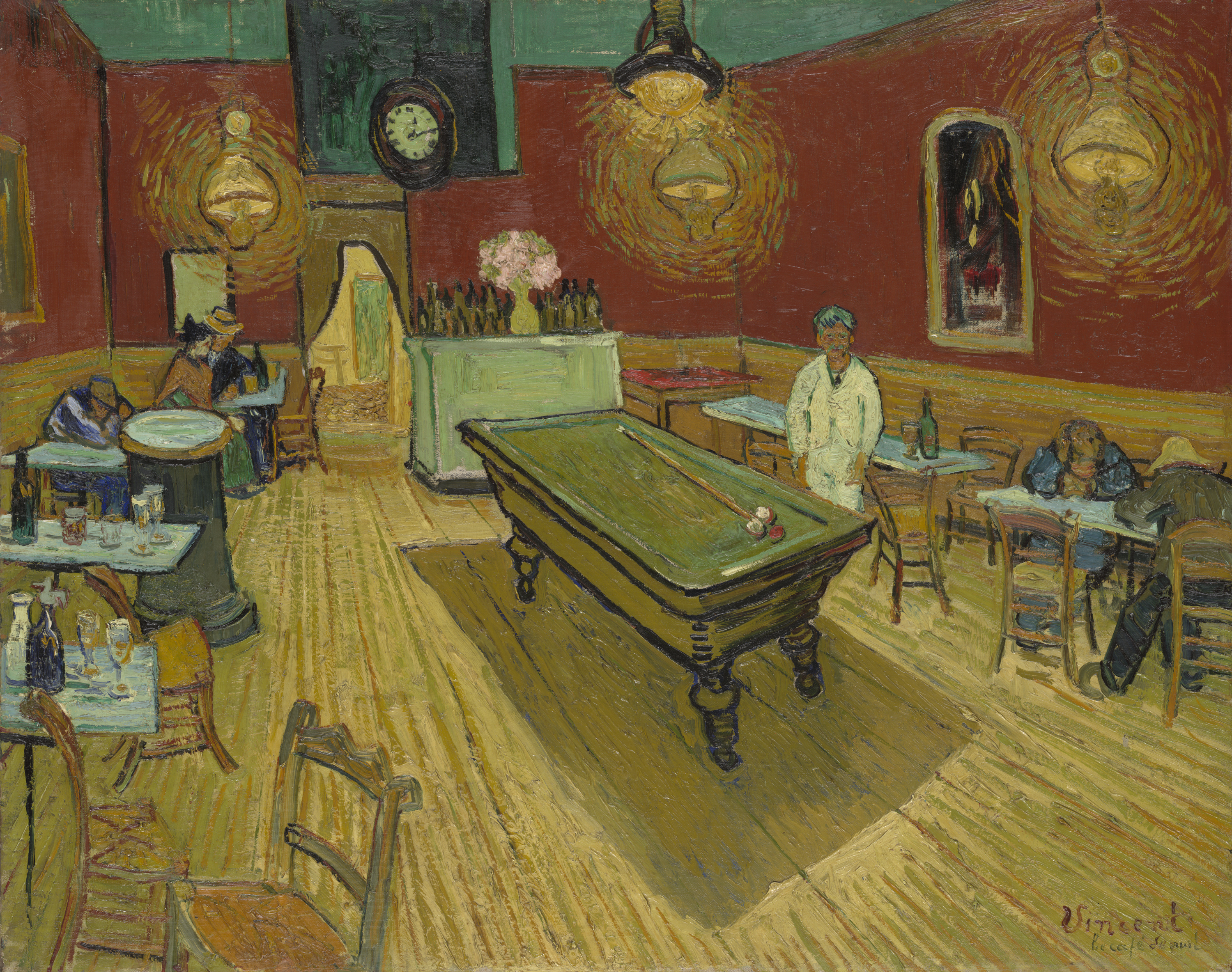
- Looks as if it is painted in butter icing; paint caked on, thick, textured
- generous use of pigments
- awkward to look at
- paint mixed on the surface, used straight from the tube
- depicts the subject in thick black outlines
- painting as a visual language; a form of therapy to depict unspoken feelings
- the light from the lamps looks ghostly
- quite ugly to look at; use of black, raw colours, drunk people
- he uses ugliness as an atheistic tool; a visual rejection of what good painting should be like
- the smartly dressed couple at the back are the only orderly looking people
- wants to be separate from the high class, different from others
- use of fantasy
- relationship with alcohol, depressing themes
- spontaneity
- self-expressive approach
As with Van Gogh, Edvard Munch possibly had mental health problems, shown in his paintings by the unsettled environment, figures caught up/trapped in difficult or emotionall traumatising situations.
The Scream, for example.
By 1910, Expressionism was being used to label work mainly produced in Germany.
- THE BLUE RIDER- a group of Expressionist artists who were seen as Avant Garde.
- Kirschner; fashionable, ahead of the trends
- having a good time, full of life
- angular figures, crammed into space, dressed in suits
- they drew on the intellectual/ academic approach by writing a manifesto
- dedicated to the unrestricted use of expression
- Franz Mark, adopted a list of colours and what they meant
- emotional content that color could communicate
- first blue rider exhibition, 43 artists - first time women were really equal and accepted in the art world in the avant grade
- how did the represent themselves? group ideas, group aesthetic, group attitude
- driven by being anti-establishment
- gabrielle munther, childlike, mixing on surface
- henry rousseau
- robert delorney
- 1911/ 1912, the war had a big impact; some fled europe, some were killed
- the work itself is more important than the visual representation
- paintings become a visual negotiation of space, material, form
- malovich, 1919, reduction, pure aesthetic form
- mondreanne, lines
- a desire for something better, a utopian vision, looking for something perfect
- taking everything away to get something as pure as it could be
WHAT IS EXPRESSIONISM?
Its not straightforward.
The word itself is a metaphorical expression of a feeling or emotion, but it might not look like that.
It may be sad, but the artist may not have been sad.
The word itself is a metaphorical expression of a feeling or emotion, but it might not look like that.
It may be sad, but the artist may not have been sad.
The feelings the audience feel are purely coincidental.
Francis Bacon was smiley and excited about his work, but the pieces were not happy at all.
The subject may look ugly but this does not mean the artist hated the subject.
The definition is BEYOND VOCABULARY. There are no words to describe it.
The notion of work always emphasizes the artist and their relationship with their work.
The artist becomes an individual who is wrapped up in their work; avant garde.
Francis Bacon was smiley and excited about his work, but the pieces were not happy at all.
The subject may look ugly but this does not mean the artist hated the subject.
The definition is BEYOND VOCABULARY. There are no words to describe it.
The notion of work always emphasizes the artist and their relationship with their work.
The artist becomes an individual who is wrapped up in their work; avant garde.

No comments:
Post a Comment