Thursday, 24 October 2013

From Modernism to Postmodernism; Exploring the Shift.

Wednesday 16th October


Modernism

Chagall, Mother and Child and Animals under a Tree, 1930s


Braque, Violin and Candlestick, 1930s

Post Modernism

Turquoise Marilyn, 1964

(Lacks progression, immature color choices, copying, isn't moving on)


Christo and Jeanne Claude, Running Fence, 1976

(Manipulation of the landscape, works outside confines of the art world)

Are these the result of Modernism falling apart?


THE DEVELOPMENT OF MODERNISM

Cezanne, Mont Saint Victoire, 1890s

(The landscape was unimportant, it was just a vehicle for him to explore the language of painting.)

Seurat, Bathers at Asniers, 1884 
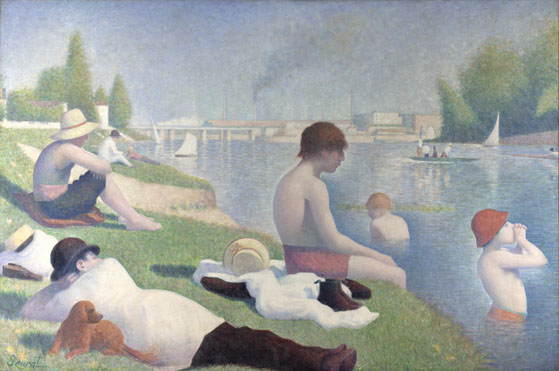
(Painted in dots like pixels and the shadows are wrong, but still shows a realistic scene.)

The development of the camera took away the need for painters to depict reality.

Van Gogh, Wheatfield with Crows, 1890 

(Represents genius, he was unique and is now celebrated. He captured landscapes and himself, suffering, tortured artist, expressive and almost like a visual autobiography.

Tatlin, Monument to the Third International, Model, 1919 

(Seen as a symbol of progression and of moving up to the new world. It was an idealistic vision of power and control. Visionary and realistic, but was never built!!! It was based on idealism and moving beyond the every day, something to be respected. The mechanical thing would have a power to speak to people, project messages. It transcends the ordinary and every day.)


HIGH & LOW

True art is 'high art', things that take effort to access. Low art is easily obtainable and accessible.

De Kooning, Woman 1, 1952 
(Obsessed with women, and although he doesn't represent her as beautiful here, we know that this is not a direct translation of his thoughts/feelings towards her.)

Jackson Pollock, in his studio, 1940s 

(Male genius of art)

Art relies less and less on realistic depictions, moving away from the reality of photography. Becoming everything that photography was not. 


Man Ray, Gift, 1921 
(Made an iron useless by welding spikes onto it)

Duchamp, L.H.O.O.Q, 1919 

("She's got a hot ass', school boy immaturity. A postcard he has doodled on.)

Richard Serra, Melnikov, 1987 
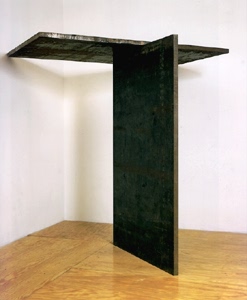
(Pieces of steel holding each other up, not even welded.)

Andre, Equivalent VIII, 1986 

(People were offended, appalled, horrified, builders said they could have made it!)

Outside of the gallery they would not be art. We rely on the environment to give it value. 
There is NO SKILL. 
Minimalism and high modernism is all about reduction, austere sparseness, taking everything away. 

Chuck Close, Self Portrait, 1960s 

(Each mosaic looks like someone else's work.)

Lichtenstein, 'Oh, Jeff…', 1964 
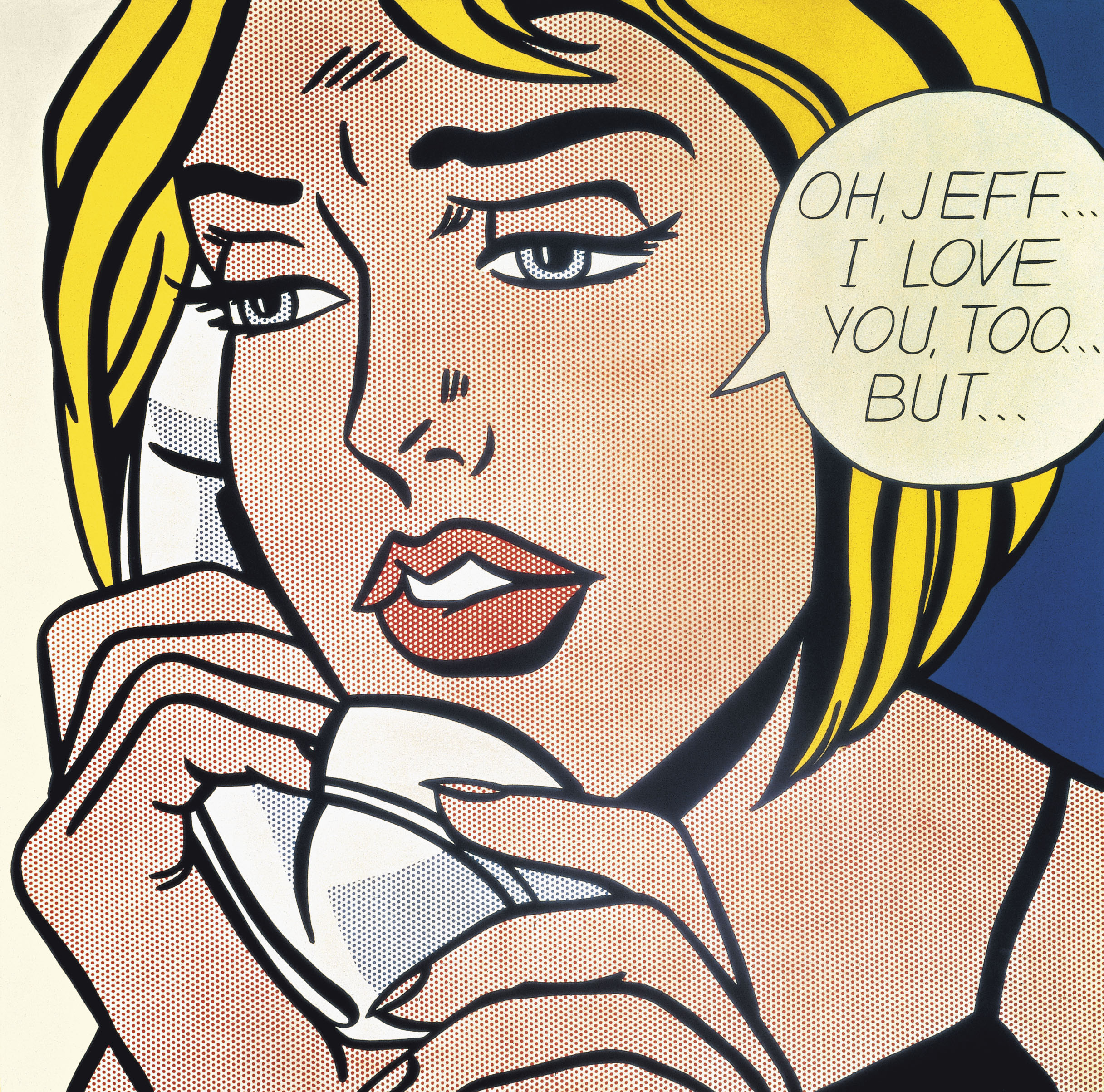

POP ART
Moved the boundary between high art and low art. Focused on popular culture and the issues that are raised about commercialism. Focus on visual impact and universal messages, that are completely meaningless of so involved that they become ludicrous. 
How can you say 'I love you' in the commercial and really mean it?

BEAUDRILLARD's theory on pop art.

Ofili, The Holy Virgin Mary, 1996 
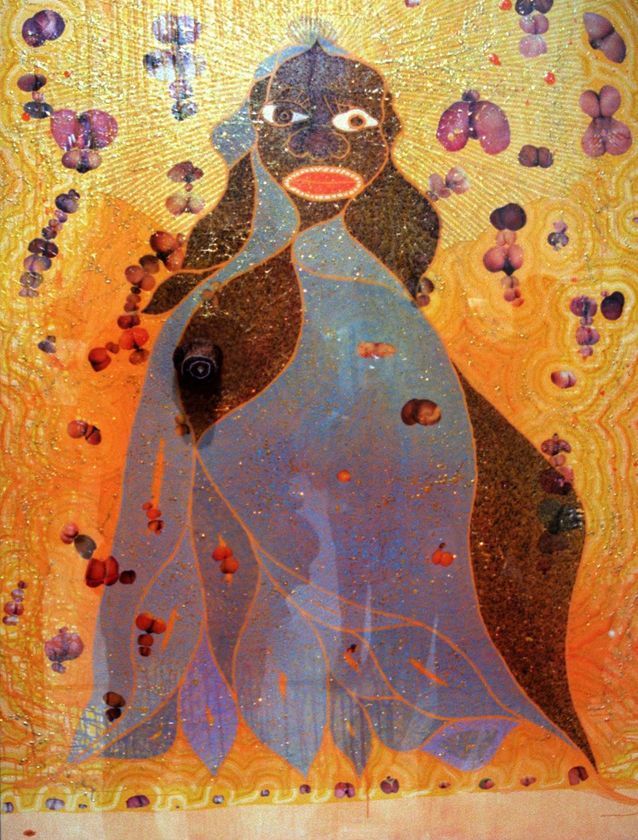
(Virgin Mary as a black woman, with pornographic images.)

Dion, Concrete Jungle, 1996 
(Representation of death and survival, uses found objects)

Post Modernism is a pluralism of art styles. In modernism these would not have worked because it relied on a narrative that was refined and simple and straight forward. Art speak protected modernism. Post modernism borrows it's languages from all sorts of disciplines. The way we read things require a certain language so that they aren't misread or misunderstood. We see the freedom with which Post Modernism uses as a tool for creative practice, creative acts. Post Modern art approaches mixed media, hybridization, layering and recontextualisation. 

Nam June Paik, Electronic Superhighway, 1995

Daniel Burren (Stripy thing, commercial work, seems accidental)

Jenny Holzer "Protect me from what I want"

Koons, pornographic images shown in galleries

Cattelan, realistic sculpture of the pope being killed by a meteor


David Shringley, next to his own work, a taxidermy dog

Thursday, 10 October 2013

Expressionism and the Meaning of Expression

Wednesday 9th October

Observation V Experience

In this lecture we looked at Expressionism and how it evolved, how different painters achieved different feelings from their pieces, and the true meaning of expressionism. (Please excuse my lack of prose towards the end; my notes in bullet form are still easy to understand, but I ran out of steam to translate it all into flowing paragraphs...)

The artist's studio is quite a common subject for artists.

The Salon- 1854, Gustave Courbet


We can see the artist in the center, with groups of people either side of him. There is a clear divide between social classes; high society and low society. The richer folk are on the right where the lower class are on the left. Yet all seem to be brought together by a shared appreciation for the artist. There is also a nude model stood by the artist even though the painting he is working on is clearly not a nude study, but a landscape. This is a modern painting of the modern world (at the time is was created).


Red Studio- 1911, Matisse


This painting is more insular, more personal than the first. It's a very abstract representation of Matisse's workspace, and yet it is clearly an artist's studio because of the typical elements we can see around the room, such as paintings, easels and the like. The largest abstraction is the minimal palette he has used, which is essentially just red, yellow and black. There is a rather flat technique with not much attention paid to dimensional proportions. The artist himself is not present in the painting, but it is typical of his particular style; Fauvist.


Kirchner's Berlin Studio (photograph)- 1919, Robert Kirchner


Once again we can see the familiar objects of an artist's studio; a sofa, paintings, a model, and other random supplies that one would expect to find in a space where a lot of time and energy is spent. The big question is why the model is dressed and yet the artist himself is nude? The answer is not very clear, but again, as I mentioned in a previous post, we only see what the artist wants us to see. He wants us to see a devil-may-care, bohemian, eccentric artist who has chosen to be different and fun and energetic. 


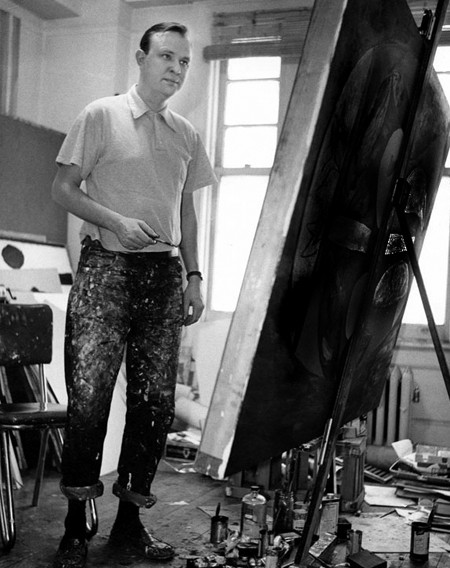
Robert Motherwell, photo 1962


This photograph differs greatly to Kirchner's representation of a studio. The space looks much more typically 'arty' and less like a relaxed 'hangout zone'. The artist is dressed in clothes that were seen as fashionable and edgy at the time; big boots, jeans and a polo shirt. He looks typically manly and is concentrating seriously on his work as opposed to looking at the camera. Once more, though, we can clearly see standard artist supplies like paints, canvasses, easels etcetera. Another similarity to Kirchner's photograph is that they are both black and white, but this may be coincidence on Motherwell's part as to whether he chose to use black and white film or not.


These paintings show the relationship between the artist and the studio as varying over time.


Meeting- 1854, Courbet


In this painting we can see Courbet himself greeting the rich bourgeoisie gentleman who commissioned the painting. There is a clear difference in dress-- Courbet looks casual, whereas the patron looks formal and rigid-- although not in respect or social standing. Courbet and the patron would have both been greatly respected. This demonstrates relationships, attitudes and critical distance between them.


VIDEO-- An interview with Francis Bacon

In the video, Bacon said he aimed for the following in his work:

- visual shock
- spontaneity, recklessness
- no real meaning
- intuitively knowing when it was complete


UNDERSTANDING EXPRESSIONISM

Expressionism
- A distortion or emotion to exaggerative effect.
Expressionism UNLIKE CUBISM, uses intense color, exaggerative brush strokes, disjointed space.

Tolstoy says everything is art, if it evokes feelings.

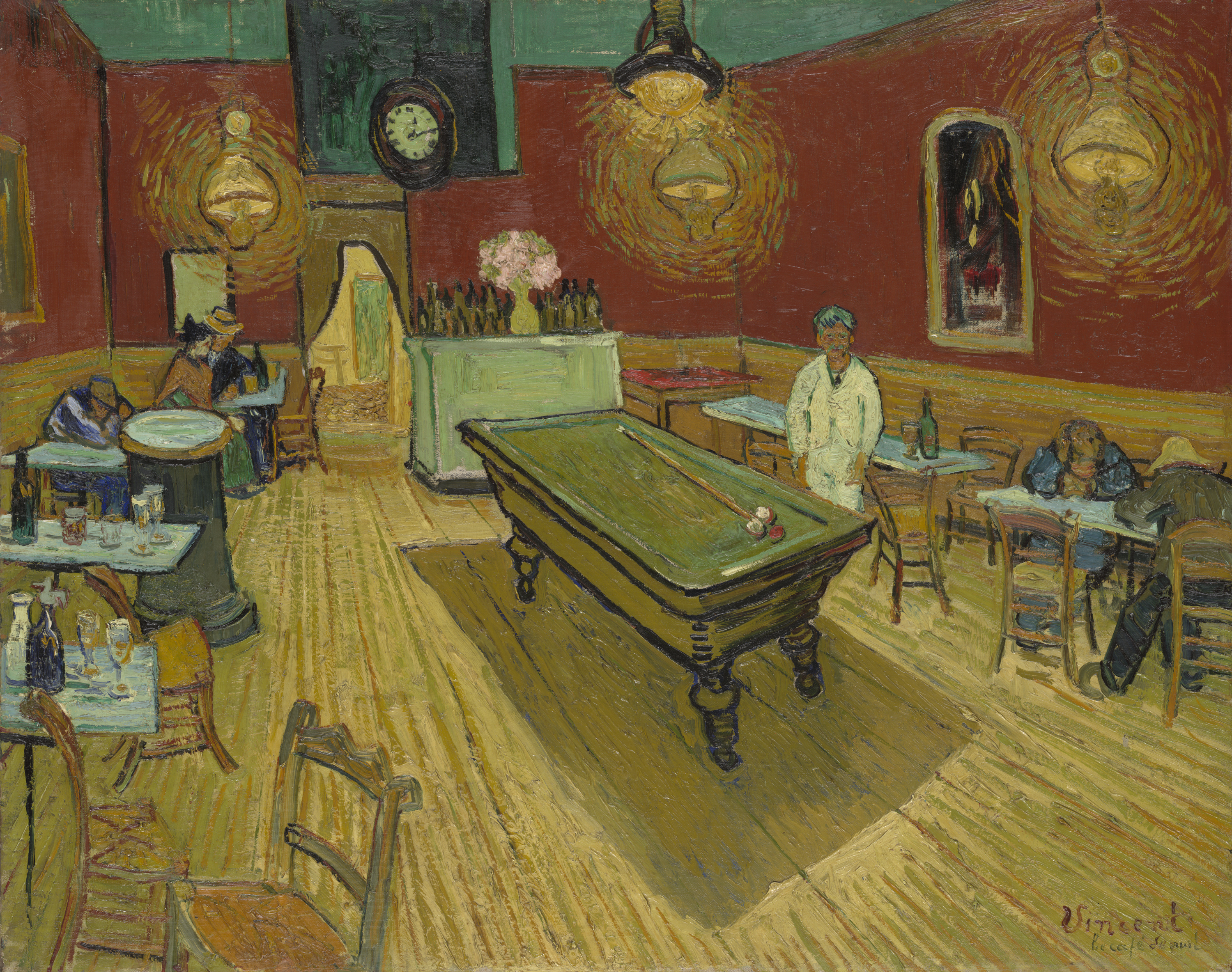
The Night Cafe- 1888, Vincent Van Gogh


- Looks as if it is painted in butter icing; paint caked on, thick, textured
- generous use of pigments
- awkward to look at
- paint mixed on the surface, used straight from the tube
- depicts the subject in thick black outlines
- painting as a visual language; a form of therapy to depict unspoken feelings
- the light from the lamps looks ghostly
- quite ugly to look at; use of black, raw colours, drunk people
- he uses ugliness as an atheistic tool; a visual rejection of what good painting should be like
- the smartly dressed couple at the back are the only orderly looking people
- wants to be separate from the high class, different from others
- use of fantasy
- relationship with alcohol, depressing themes
- spontaneity
- self-expressive approach

As with Van Gogh, Edvard Munch possibly had mental health problems, shown in his paintings by the unsettled environment, figures caught up/trapped in difficult or emotionall traumatising situations. 
The Scream, for example.

By 1910, Expressionism was being used to label work mainly produced in Germany.

- THE BLUE RIDER- a group of Expressionist artists who were seen as Avant Garde.
- Kirschner; fashionable, ahead of the trends
- having a good time, full of life
- angular figures, crammed into space, dressed in suits
- they drew on the intellectual/ academic approach by writing a manifesto
- dedicated to the unrestricted use of expression
- Franz Mark, adopted a list of colours and what they meant 
- emotional content that color could communicate
- first blue rider exhibition, 43 artists - first time women were really equal and accepted in the art world in the avant grade
- how did the represent themselves? group ideas, group aesthetic, group attitude
- driven by being anti-establishment
- gabrielle munther, childlike, mixing on surface
- henry rousseau
- robert delorney
- 1911/ 1912, the war had a big impact; some fled europe, some were killed
- the work itself is more important than the visual representation
- paintings become a visual negotiation of space, material, form
- malovich, 1919, reduction, pure aesthetic form
- mondreanne, lines
- a desire for something better, a utopian vision, looking for something perfect
- taking everything away to get something as pure as it could be

WHAT IS EXPRESSIONISM? 
Its not straightforward.
The word itself is a metaphorical expression of a feeling or emotion, but it might not look like that.
It may be sad, but the artist may not have been sad. 
The feelings the audience feel are purely coincidental.
Francis Bacon was smiley and excited about his work, but the pieces were not happy at all.
The subject may look ugly but this does not mean the artist hated the subject.
The definition is BEYOND VOCABULARY. There are no words to describe it.
The notion of work always emphasizes the artist and their relationship with their work.
The artist becomes an individual who is wrapped up in their work; avant garde.

Wednesday, 9 October 2013

Cubism: Abstraction and Intellect

Wednesday 2nd October 2013

In this lecture we looked at the origins of Cubism and how it came to be known. Many people of and around the era would refer to it as the product of "two guys messing around in a studio", and did not deem it serious art, whereas Picasso and Baque themselves obviously would not agree.

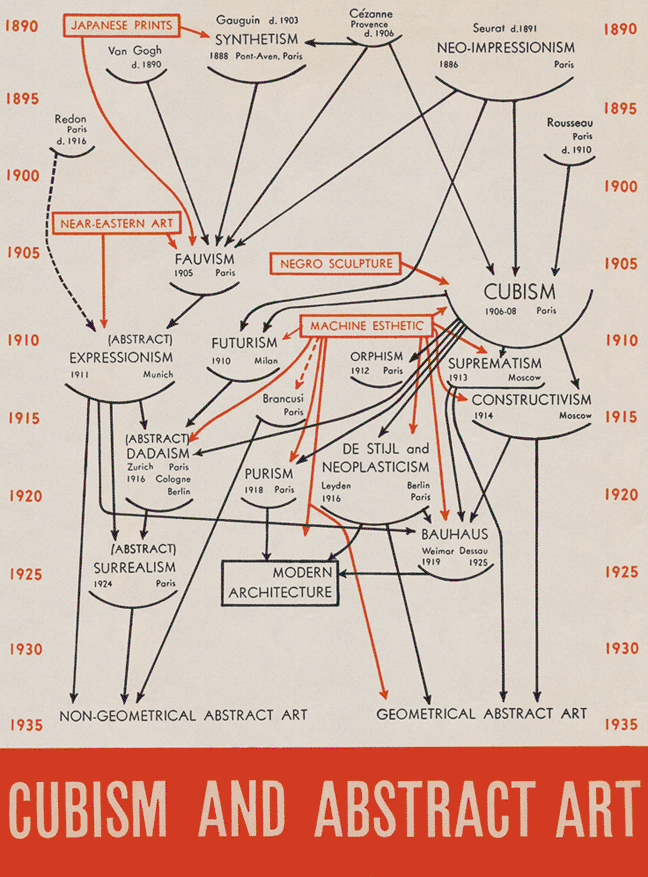
The era itself was around the time of European Modernism in the 20th Century. We can see Alfred Barr's interpretation of the evolution of art styles in the cover of his piece 'Cubism and Abstract Art':


Cultural movements around this time included Cubism and Fauvism. Cubism was a rejection of traditional thought and ideology, especially where art was concerned. In the world around the artists this was also the case, with mass urbanisation taking place and the favour of new technology and scientific leaps in terms of medicine. For many artists (as well as other people around this time) there was an idea of a 'Utopian Vision'; an idealistic world akin to a paradise for us to aspire to.

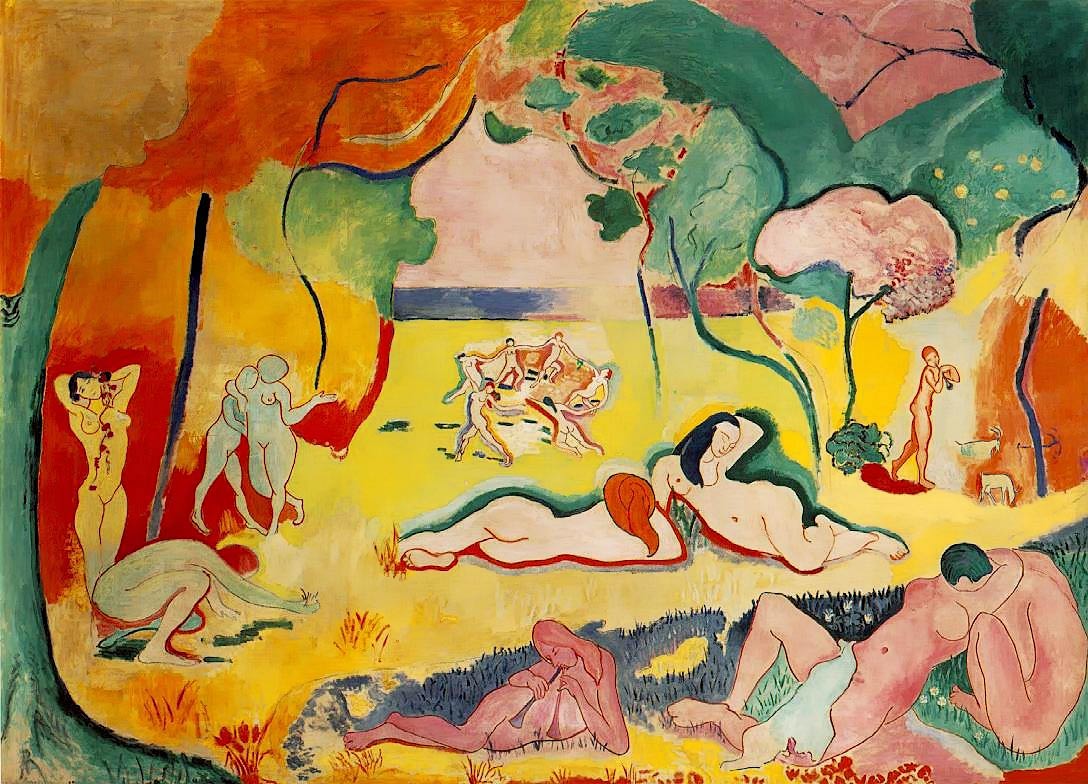
The Joy Of Life by Matiss is a key example of a Fauvist artwork:


Note the vibrancy of the colour and the irregularity of form; he wasn't aiming to please the audience in particular, but rather to get across a new and avant garde way of seeing his environment. He was exploring the flatness of his canvas through his medium, which most (if not all) Cubists and Fauvists did. Nudes were a common motif we see in Fauvist artworks, exemplified here by Matisse.

In Picasso's Les Demoiselles D'avignon we can see a clear development of modernism:


This image is a allegory; it is a representation of abstract ideas or themes through the use of characters and images on the canvas. The painting depicts prostitutes surrounded by curtains, and a bowl of fruit which would have been gifted to them by their patrons to help keep them healthy. Picasso was influenced by other things while he was in the process of painting this piece, thus the reason for two of the prostitutes on the right hand side to be wearing masks. Again, this piece is avant garde.

Look at these two paintings (both by Cézanne):


In this painting we see a clear visual representation of a landscape. It is very easy to pick out the mountain in the background, the tree in the foreground and the field in the mid-ground. The brush strokes are small, light and rather minimal, with every form looking relatively realistic. The image looks as one would see it if you were stood where the artist had been stood.


However in this second painting, the image is not so obviously clear. We can tell that it is a mountain, but only because of the overall shape that the artist has created using oddly place brushstrokes. The paint is much thicker than in the first painting and everything is much more abstract. So although we know what the painting is depicting, we also know that it is also an exploration of the artist's medium and of the space he has on his canvas, exploring the flatness.

This was seen as quite an innovative approach to painting at the time, and was often rejected by audiences who preferred a more traditional style of painting that was aesthetically pleasing.


Picasso and Braque were brought together by one of their early supporters, Daniel Kahnweiler who insisted that they would work well together. After a while, their artworks became almost indistinguishable from one another and they seemed to create their pieces using a unique visual language that only they understood. There was a distinct focus on form and space, and a rather noticeable removal of colour which often left the paintings monochromatic.

Oftentimes the audience would be insulted because they believed artwork was supposed to be made for them to enjoy. Cubism stripped away everything that they were comfortable with and left them feeling unsatisfied with whichever exhibition they were in at the time. They wanted to be aesthetically pleased, and instead they were faced with zero expression of emotion, a cool, dry, detached experimentation with structure that seemed fractioned, too angular and very disjointed.

This is what gives rise to the term 'Analytical Cubism'; a systematic study of structure. There are often panels, facets, and shades of light and dark in planes of emptiness. The lack of colour thus draws all the focus into the structure of the painted subject.

But after all, art is a representation, an interpretation. So did the audience have a right to be angry?

Freud asked the question 'What is real? What is imaginary?'. What is the difference between the private and the shared? We only see what the artists want us to see.