In this lecture we looked at the origins of Cubism and how it came to be known. Many people of and around the era would refer to it as the product of "two guys messing around in a studio", and did not deem it serious art, whereas Picasso and Baque themselves obviously would not agree.
The era itself was around the time of European Modernism in the 20th Century. We can see Alfred Barr's interpretation of the evolution of art styles in the cover of his piece 'Cubism and Abstract Art':
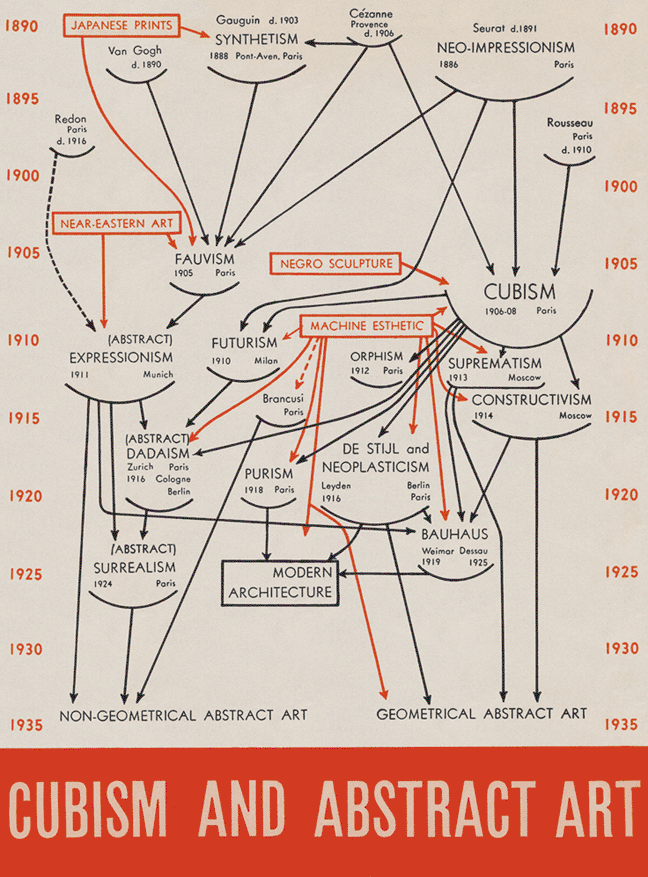
Cultural movements around this time included Cubism and Fauvism. Cubism was a rejection of traditional thought and ideology, especially where art was concerned. In the world around the artists this was also the case, with mass urbanisation taking place and the favour of new technology and scientific leaps in terms of medicine. For many artists (as well as other people around this time) there was an idea of a 'Utopian Vision'; an idealistic world akin to a paradise for us to aspire to.
The Joy Of Life by Matiss is a key example of a Fauvist artwork:
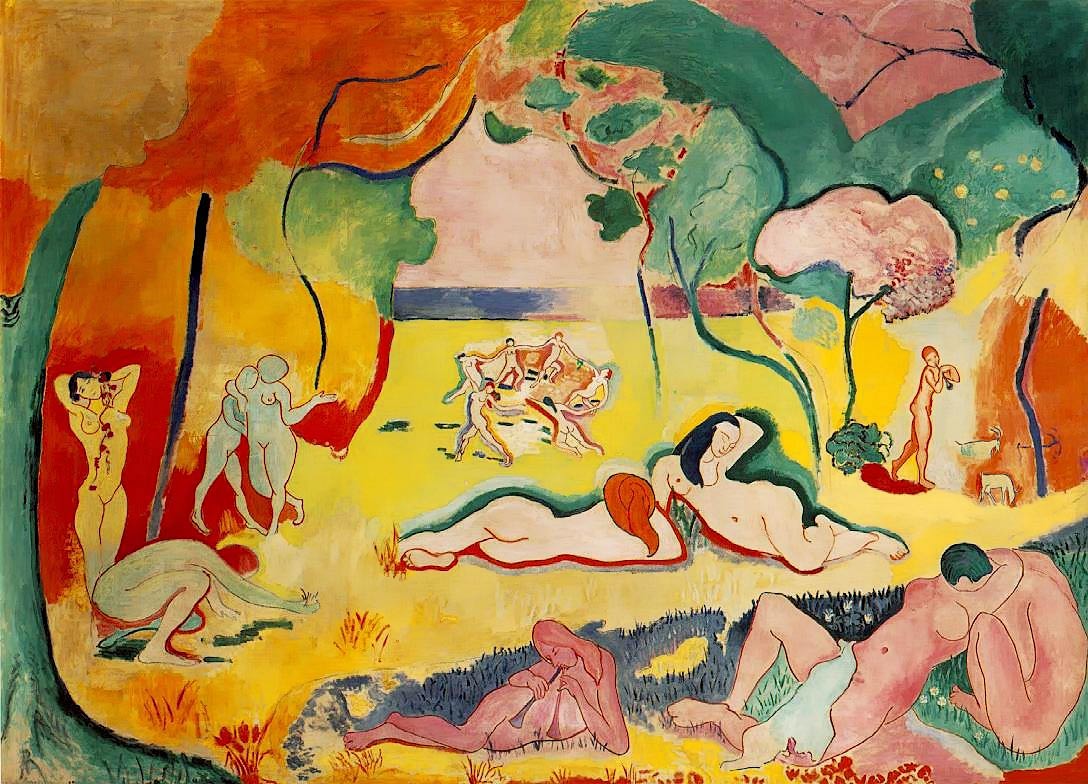
Note the vibrancy of the colour and the irregularity of form; he wasn't aiming to please the audience in particular, but rather to get across a new and avant garde way of seeing his environment. He was exploring the flatness of his canvas through his medium, which most (if not all) Cubists and Fauvists did. Nudes were a common motif we see in Fauvist artworks, exemplified here by Matisse.
In Picasso's Les Demoiselles D'avignon we can see a clear development of modernism:

This image is a allegory; it is a representation of abstract ideas or themes through the use of characters and images on the canvas. The painting depicts prostitutes surrounded by curtains, and a bowl of fruit which would have been gifted to them by their patrons to help keep them healthy. Picasso was influenced by other things while he was in the process of painting this piece, thus the reason for two of the prostitutes on the right hand side to be wearing masks. Again, this piece is avant garde.
Look at these two paintings (both by Cézanne):

In this painting we see a clear visual representation of a landscape. It is very easy to pick out the mountain in the background, the tree in the foreground and the field in the mid-ground. The brush strokes are small, light and rather minimal, with every form looking relatively realistic. The image looks as one would see it if you were stood where the artist had been stood.

However in this second painting, the image is not so obviously clear. We can tell that it is a mountain, but only because of the overall shape that the artist has created using oddly place brushstrokes. The paint is much thicker than in the first painting and everything is much more abstract. So although we know what the painting is depicting, we also know that it is also an exploration of the artist's medium and of the space he has on his canvas, exploring the flatness.
This was seen as quite an innovative approach to painting at the time, and was often rejected by audiences who preferred a more traditional style of painting that was aesthetically pleasing.
Picasso and Braque were brought together by one of their early supporters, Daniel Kahnweiler who insisted that they would work well together. After a while, their artworks became almost indistinguishable from one another and they seemed to create their pieces using a unique visual language that only they understood. There was a distinct focus on form and space, and a rather noticeable removal of colour which often left the paintings monochromatic.
Oftentimes the audience would be insulted because they believed artwork was supposed to be made for them to enjoy. Cubism stripped away everything that they were comfortable with and left them feeling unsatisfied with whichever exhibition they were in at the time. They wanted to be aesthetically pleased, and instead they were faced with zero expression of emotion, a cool, dry, detached experimentation with structure that seemed fractioned, too angular and very disjointed.
This is what gives rise to the term 'Analytical Cubism'; a systematic study of structure. There are often panels, facets, and shades of light and dark in planes of emptiness. The lack of colour thus draws all the focus into the structure of the painted subject.
But after all, art is a representation, an interpretation. So did the audience have a right to be angry?
Freud asked the question 'What is real? What is imaginary?'. What is the difference between the private and the shared? We only see what the artists want us to see.

No comments:
Post a Comment